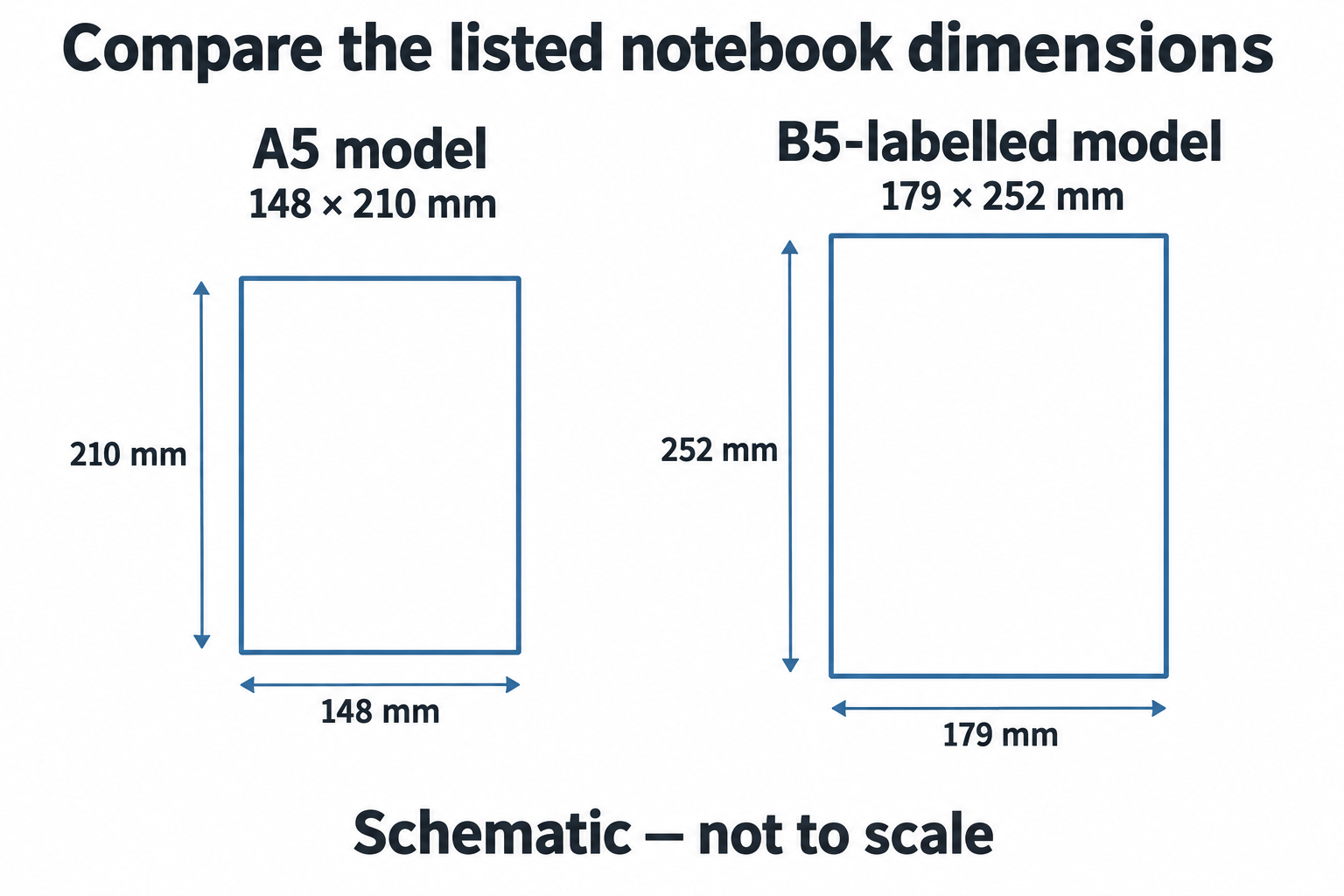
| Specification | A5 NO-105BN | B5-labelled NO-3CBN-B |
|---|---|---|
| Exterior dimensions | 148 × 210 mm | 179 × 252 mm |
| Ruling / lines | 6 mm / 28 lines | 6 mm / 35 lines |
| Included sheets | 50 | 30 |
| Choose when | Carry space is limited and your sample note fits | A larger diagram or 32-line note needs one page |
Start with the space you actually use
Choose a notebook by testing its dimensions beside your usual equipment. A smaller book can be easier to carry, but that advantage disappears if every diagram needs another page. A larger page can make notes easier to scan, but only if you can open it comfortably where you work. This comparison uses published specifications, not a hands-on paper review.
The official listings give the Campus A5 NO-105BN as 210 × 148 mm and the B5-labelled NO-3CBN-B as 252 × 179 mm. Those are the dimensions to use for these models. Do not substitute a generic size chart when ordering a fitted cover: the actual product and the cover maker’s stated compatibility matter.
Make two free test pages
Cut or fold spare paper to each listed rectangle. Put both in the bag compartment you intend to use, then place them beside your keyboard. Make a second copy of each rectangle and position it alongside the first to approximate an open spread. This is only a footprint estimate; the binding and cover can change the space a real notebook needs.
Copy the same short passage, one diagram and one task list onto both samples. Use your normal handwriting rather than squeezing letters to make the smaller format win. If you routinely turn a page in the middle of a single idea, record that. If the larger mockup pushes your mouse out of reach, record that too.
Compare usable lines, not just the cover
These two models both have 6 mm ruling. The A5 listing specifies 28 lines and 50 sheets; the B5 listing specifies 35 lines and 30 sheets. For a note that occupies 32 handwritten lines, the larger model can contain those lines on one page while the smaller needs another page. That is a worked example, not a prediction of how much you will write.
The larger model has more room per page, but this particular A5 model contains more sheets. Keep those separate in your comparison. A sheet has two sides, yet you may choose to use only one; calculate capacity from your own habit. Do not infer pen compatibility or bleed-through performance from a page count.
Use a decision rule before shopping
Choose the A5 candidate if the mockup fits your working space and a typical note remains readable without shrinking your handwriting. Choose the B5 candidate if your diagrams or long notes benefit from its extra room and the open spread passes the desk test. If both work, compare the delivered price for the exact ruling and sheet count.
Keep your mockup with a note of the model number, dimensions and layout. It becomes a useful reference when browsing another colour or pack: a similar cover does not prove the specifications are identical. Buying one suitable notebook first gives you a way to check your actual pen and paper combination before committing to a larger quantity.
Sources and method
Generated by AI using the linked official sources. AI checks cover the cited specifications, arithmetic and consistency between text and figures. Human editorial review has not yet been completed. We have not independently tested these products. Sources checked 2026-09-10; availability and policies may change.
Explore the official selection
Links go to independent brand websites. We receive no commission from these links. Prices, stock, US delivery and any import charges must be checked with the seller.